
From Survivor Memory to Living Teller
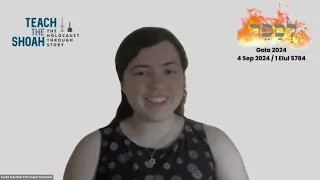
Storyteller Acadia Schecter tell the story of Survivor Vera Kastenberg. And Vera responds.
I promise to keep your memory and tell your story.
One by one, eight storytellers stand in front of a Holocaust survivor and make this promise. These young adults, ranging in age from 19 to 22, have spent the last six weeks getting to know the survivors and learning to tell their stories – learning to be the keepers of their memories. The survivors have just heard the stories for the first time. The moment is emotional for everyone involved and moving for everyone watching.
The students have just completed a special TTS training course: five weeks of twice weekly online classes and an intensive week-long in-person storytelling bootcamp. They learned to interview the survivors with care and compassion. They learned to understand what they heard. And they learned to take those memories and retell them in their own words.
In the months since, these young storytellers have brought the survivors’ stories to hundreds of people who might otherwise never have had the chance to hear such a story in person.
It was totally different from how I present my own story. Very, very insightful. I’m almost emotional and I’m not an emotional person, so I want to thank you.
This is all we ask – share, share our story.
Storyteller Acadia Schecter tell the story of Survivor Vera Kastenberg. And Vera responds.
Lesaper: A Race Against Time
At the 2024 annual meeting of the Association of Holocaust Organizations in New York, a representative from the Claims Conference said, “Ten years ago, survivors asked us: How can I get home healthcare? Now they also ask us: Who will tell my story?“
From this comment, Lesaper: From Survivor Memory to Living Teller was born. Lesaper means “to tell” in Hebrew.
The aim of Lesaper is to create direct connections between the next generation of storytellers and living survivors. We have very little time left.
The First Cohort
When we were approached, we jumped at the opportunity to say yes, because we found so many shared values and a shared commitment to ensuring that the history of the Holocaust and its enduring lessons resonate across generations.
The first Lesaper cohort paired 8 college students (“fellows”) from Arkansas with 7 survivors – 6 from Los Angeles, CA and one from Washington, DC. We partnered with Holocaust Museum LA, where most of the survivors were volunteers. Each of the fellows was paired with a single survivor. One survivor, Eva Brettler from LA, was paired with two fellows.
Online Training
The initial training and interviews occurred online. Under the guidance of instructors trained by the Shoah Foundation in interviewing survivors, the fellows conducted three interviews with their matched survivor: focusing on the survivor’s pre-war, wartime, and post-war experiences respectively.
During this time, they began to develop deep relationships with the survivors.
The fellows then worked with our professional storytelling instructors to take what they’d heard and begin to turn it into a story they could tell.
Bootcamp in LA
At the end of this online training, the fellows and instructors gathered in Los Angeles for an intensive week-long bootcamp, to complete the stories and meet the survivors in person. Meeting in person cemented the close personal tie between survivor and fellow. For the fellows, telling the survivor’s story became more than a contract; it became a commitment
Before they returned home, the fellows presented their stories to the survivors and their community in the library at Holocaust Museum LA. Standing in front of the survivors, they promised to carry on each survivor’s memory and to continue to tell their stories.
An Unlikely Group
There are no requirements of Lesaper storytelling fellows except that they commit to preserving and sharing the survivors’ stories throughout their life. For some cohorts, fellows are local – living near the survivors and our partner museums. For others, the fellows fly in from elsewhere to meet the survivors in person. The first cohort was one of the latter.
At the time of the program, all eight fellows were undergraduate or graduate students at the University of Arkansas in Fayetteville or the University of Central Arkansas in Little Rock. None are Jewish, and only one has a background in Holocaust history. Nonetheless, when the opportunity arose, they embraced it, understanding they were making a life-long commitment.
We could not be prouder of the work these young people did. Over the course of six short weeks, they grew from complete novices about Judaism, the Holocaust, and storytelling into Keepers and Tellers of Holocaust Memory.
In a 2020 survey of Holocaust knowledge among millennials in the US, Arkansas came in last – 50th out of 50 states. Now, eight young storytellers are out in their communities working to change that.
After listening to Torrie Herrington tell her story, sculptor Gabriella Karin was inspired to create this piece, entitled
Lesaper – Beginning of a New Era, Keeping Truth and the History Alive
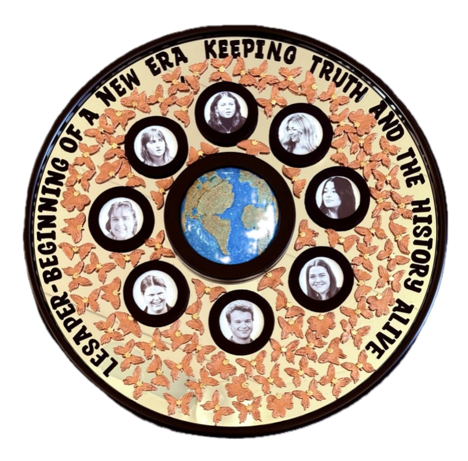
Clockwise from the top: Torrie Herrington, Riley Farco, Maddi Ruiz, Libby Holden, Cooper Horton, Emily Hand, Sarah Dilatush, Brenna Metts.
From the Stories
From Lya Frank’s Story
As told by Riley Farco
I’ve always liked to envision that there is this invisible string that ties together sisters. Sisterhood is a bond that can’t be broken. No time, nor space, nor attempted genocide could’ve kept Lya from Ellie.
From Eva Brettler’s Story
As told by Cooper Horton
Thanks to the lessons her mother gave her, the kindness and generosity of strangers in the concentration camps, and her own will to live, that little girl, that curious, slightly rebellious, independent, innocent little girl who ran chasing after the music in Kluge, Romania, had survived.
From Eva Brettler’s Story
As told by Libby Holden
These memories aren’t in the material things. They are in our hearts and in our souls. And unlike [my lost] ring, these memories will never be lost.
From Henry Weil’s Story
As told by Maddi Ruiz
That was the day I truly learned that my family did escape something horrific. And I realized that being a delivery boy wasn’t just my role when I was a child, but it would be on me to deliver my message and my story for the rest of my life to make sure that this never happened again.
From the Survivors
I speak regularly but hearing my own life from somebody else’s tongue, it’s totally different. I just want you to know that I treasure all the time we spent together and I hope our relationship will continue.
Both of you, that you will carry on the story of my life – I am so, so honored. Because a little child at age 8 survived. And to be able to share their stories with the future generation – it’s so meaningful. And I thank you.
And please, please share it.
Maddi, I want to thank you first of all for what you are doing and to tell you how important the work is that you and your fellow students are doing. Because you are perpetuating the story of the Holocaust. Once we’re gone, the survivors, it’s not going to be the same. It’s very, very important that the story continues on.
Preserve History, Empower Voices
SUPPORT US
By donating to the Survivor Memory to Living Teller project, you are not only honoring the memories of those who lived through the Holocaust but also empowering the next generation to keep these stories alive.
Their Stories, Our Future
PASS ON THEIR LEGACY
Work with us to preserve the immediacy of survivor testimony by developing CUSTODIANS OF MEMORY: young adults trained as keepers and tellers of for the survivors in your community.
Survivors:
- Partner with young, passionate individuals who will carry their memories to the next generation by telling their story.
- Share their experiences through a series of personal interviews, ensuring their story is preserved with the utmost care and respect.
- Know that their story will be shared with authenticity and historical accuracy.
Storytellers:
- Are 18 to 30 years old and passionate about social justice and preserving memory.
- Receive expert training in interviewing survivors and developing authentic stories grounded in testimony and history.
- Act as a bridge between generations, bringing the survivor’s story to new audiences.