
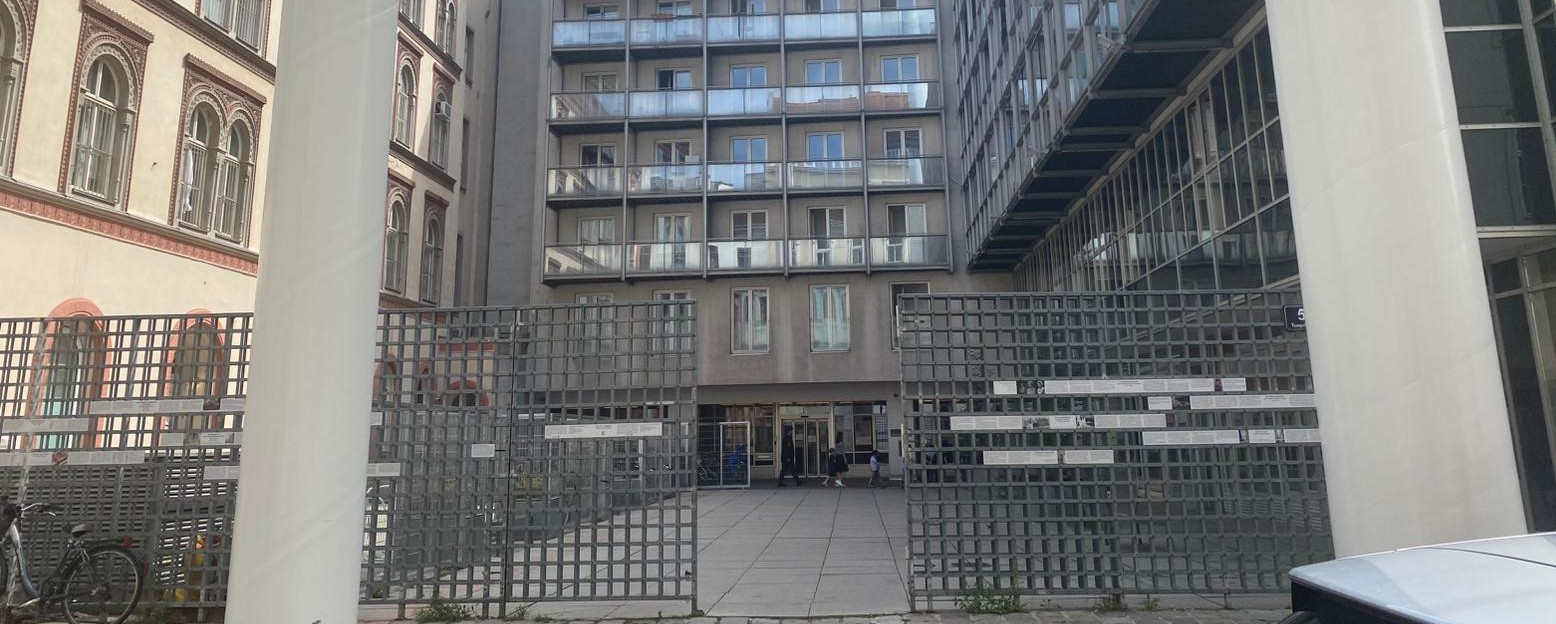
Every day, I watch as people pause to look at the four enormous white pillars in the street in front of my apartment building. These pillars represent the original pillars of the Leopoldstädter Temple, once the largest synagogue in Vienna with the capacity to hold services for over 3,000 congregants.
For the last five weeks, I’ve been living in a flat in what was once the right annex of the Temple. Walking into the building for the first time made me smile. It felt like it was meant to be – a Holocaust researcher staying in a site of memory.
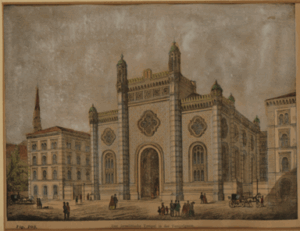
Dr. Viktor Stellamor, Wien – Aquarellierter Druck Sammlung Stellamor V
It was more than a synagogue; it was a place for the community. The complex also included a mikvah, meeting rooms, learning rooms, and a library.
Every day walking by what used to be a grand complex of Jewish life, I imagine what it looked like back then. I imagine what it would have sounded like walking in on a Friday evening for Shabbat prayers, what it would have felt like sitting in the great library.
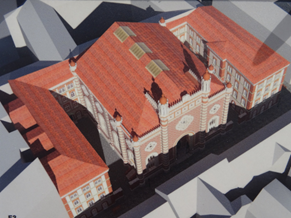
[Austria Forum]
Today as I walk by, I can still hear the laughter of children. I hear Hebrew, Yiddish, and German all mixed into voices of the new, revived Jewish community of Leopoldstädt. These young vibrant children, rushing by in the morning on their way to school, are a modern echo of a community that once was.
The Destruction of the Leopoldstädter Temple
The Anschluss: the annexation of Austria into the German Reich on March 12, 1938. The day that changed everything for the Jewish community of Vienna.
On the Eve of the Anschluss, the Jewish community in Vienna was vibrant, assimilated, and acculturated. Many of the 206,000 Jews living in Vienna were registered as members of the community. During the Great War (WWI), many Jewish men served in the imperial army.
The Anschluss changed all of that. The German anti-Jewish laws that went into effect almost immediately caught the community by surprise. Within five days of the Anschluss, the central offices of the Jewish community were closed. The 1935 Nuremberg laws were instated. Jewish humiliation and forced labour became a daily sight in Vienna. Jewish men and women, caught in the street, were forced on their hands and knees to clean and scrub the sidewalks.
By August of 1938, the Central Agency for Jewish Emigration (Zentralstelle für jüdische Auswanderung in Wien) was established. The agency, overseen by Adolf Eichmann, forced as many able Jews as possible to emigrate out of Austria.
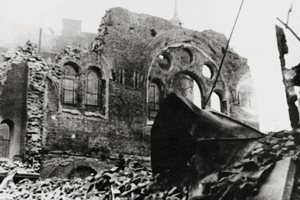
[Austrian Archive]
One of the few recordings from the event, a radio report made from outside the temple, is a disturbing insight into the rampant hatred of Jews of the time. “The outraged inhabitants, Aryan inhabitants of this district, did not miss the opportunity, after this heinous crime in Paris, to show their abysmal hatred towards Judaism here too. The Jewish Temple was engulfed in flames in a matter of minutes.”[1]
What was left
The Israelitische Kultusgemeinde Wien (IKG, the Jewish Community of Vienna) cleared away the rubble of the main temple building. For some time, they tried to keep the school running in the still intact left annex, but the anti-Jewish laws soon forced the school to close. For some time afterwards, the building was used as a day nursery. From 1942, it was a children’s home. Some of the teens from the home found work nearby and for a while, were protected from deportations.
A children’s hospital was established in the right annex in 1941. It was the only place where Jewish children could receive any kind of healthcare during the war years.
Today
Today, the left annex is home to a synagogue, a Jewish religious school, and a mikveh. The right annex was destroyed at the end of the war and rebuilt in 1955. Now it serves as an apartment building – the very building in which I have been staying. There is a plaque in the main entrance corridor commemorating the beautiful temple that once graced this site.
The four white pillars outside are a monument erected in 1998 by the Jewish Austrian architect Martin Kohlbauer. The square in which the original main building stood was left empty, a contemplative courtyard between the two annexes.
Photos and texts explaining what once stood here are laced in the metal gate in front of the courtyard. On the side, stumbling stones have been placed in the street, representing some of the people who lived in the left annex during the war.
People stop and read the writings on the gate, looking at the pillars and taking their time with this place of memory. Sometimes I hear them talking quietly about what they have just read. Sometimes they are silent.
Once in a while, a guided tour stops to contemplate the monument. These mainly Jewish groups listen as their guide tries to describe the grandeur of the complex that once stood here, the vibrancy of Jewish life that occurred within it, and the scale of the destruction.
Holding on to Jewish memory
In the weeks before coming to Vienna, I attended a conference in Upper Silesia in Poland. After the conference, I explored some of the many sites of memory located in that region, including some of the Auschwitz subcamps. I was unsettled by the extent to which the Jewish presence is being erased there. Many of the plaques at Auschwitz subcamps mention Polish prisoners but not Jews, and a local activist who created one of them told us that it didn’t matter. In some places where Jews died in death marches, they are buried under crosses.
Living inside a preserved site of memory in Vienna immediately after that experience created a dissonance I’m still trying to process. In Austria, the relationship to their Nazi past is complex and in many ways still unresolved. Nonetheless, I found myself surrounded by visible, deliberate efforts to preserve Jewish memory and keep Jewish life present.
In Poland, especially in the region of Upper Silesia, the absence of Jewish memory often felt overwhelming. Now, after a series of recent acts of memory distortion – like in the town of Jedwabne, where a plaque commemorating a massacre of Jews by their Polish neighbors was replaced with one that falsely claims Germans were to blame – that absence feels even sharper.
Yet here in Vienna, I woke each morning to the sound of Jewish schoolchildren racing past the monument of a once-grand synagogue. It didn’t feel like irony. It felt like insistence. It felt like Jewish memory refusing to be erased.
———————
[1] https://youtu.be/AUap7WXTqtE?si=o4JsWoeUBYn_3sN8. The “heinous crime in Paris” refers to the murder of Nazi diplomat Ernst vom Rath by Hershel Grynszpan, the excuse used by the Reich to start the long-planned pogrom.
Brilliant piece of writing so clearly describing the horrors perpetrated against the Jews, and the efforts made to preserve the memories of what was once a vibrant community in the middle of Vienna (applicable to all great cultural European cities). Thanks, Lynne, for this expose and sharing your personal experience
I loved the piece. You informatively sketch out for the reader what the Leopoldstadter Temple once was until 1938 and what it meant to the Jewish community of Vienna, what happened to the Temple after the Anschluss and the subsequent Kristallnacht Pogrom and what has become of the property since the end of World War II. (I am wondering if the “right annex” apartment building is also restituted as part of Vienna’s Jewish Communal property and is reserved for Jewish residents.)
Equally impactful to the discussion of the Viennese Jewish experience, is the author’s observations of today’s Austrian citizens grappling with their Nazi past and her own personal feelings as she resides on the grounds what was once a crown jewel of the Viennese Jewish community.
Thank you for sharing.
Wow, Lynne, what a beautiful text that weaves together poetry and history. In days filled with so much violence, it’s impossible not to think back to those times — and perhaps the most powerful way to reflect on them is the way you presented: through the lens of the individual, the people, the sounds of children, the small footsteps. Sometimes it feels like we’ve learned nothing, that the world has learned nothing — but you leave us with hope, and we’ll hold on to it, if only for a few moments.
This is a beautifully written article that illuminates both history and your own experience as a historian who documents the shaping of memory. I am disheartened by the erasure of Jewish memory in Upper Silesia, Poland. I am uplifted by the highlighting of pre-Holocaust Jewish life in Vienna. You interwove the present and the history in both places. Thank you for sharing the primary source material. The radio announcement from Kristallnacht is particularly disturbing. So too is the Polish activist’s claim that it does not matter that the memorial plaque does not acknowledge that those murdered were Jews.