
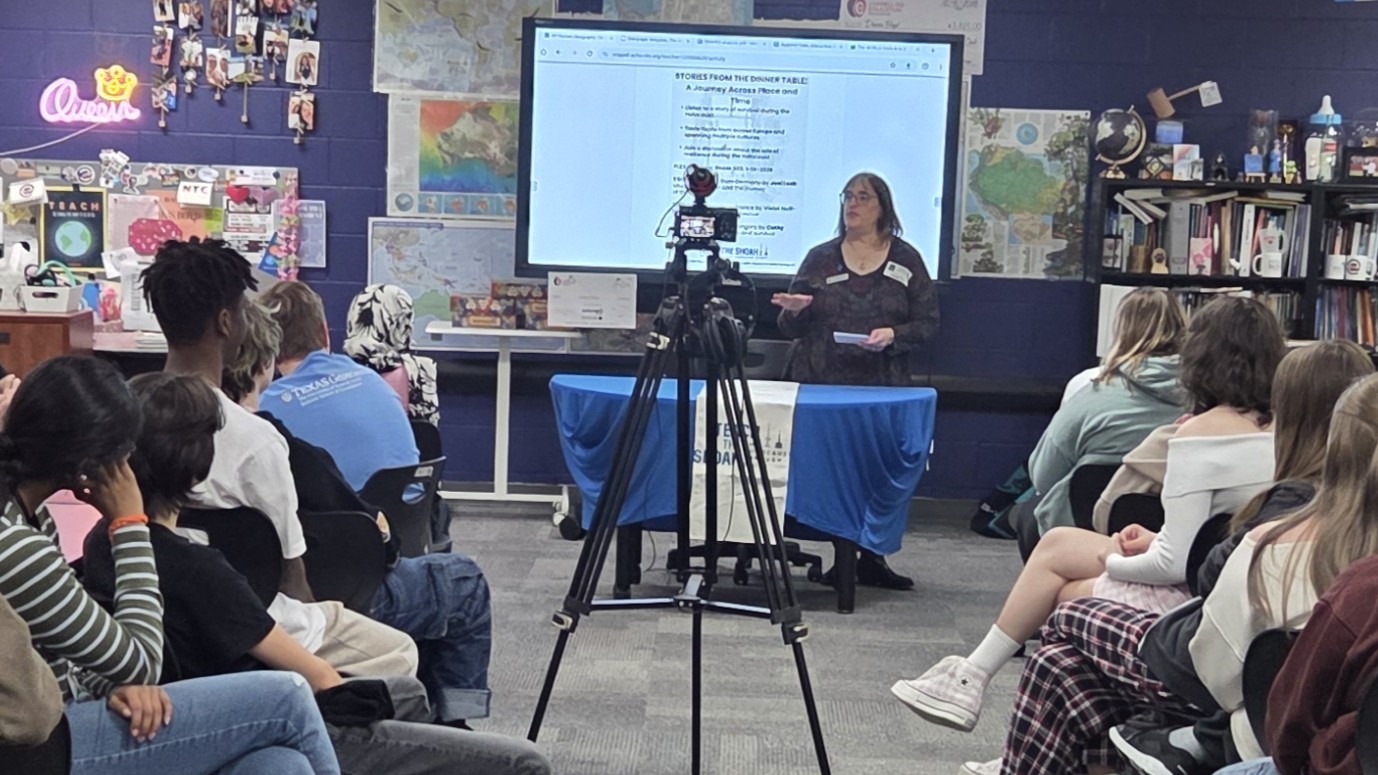
I have heard many positive things said by participants after a storytelling presentation. Some of the most memorable comments, however, have come from high school students. At a recent program at a public high school near my home in the Dallas area, we not only shared stories of the Holocaust and talked about the history, but we also talked about the assorted cultures of Jews in various places across Europe and how those cultures were impacted by the Holocaust. Many resulting comments and questions from the students were poignant and insightful, but one in particular stood out.
“I always knew [the Holocaust] was bad, but it wasn’t until I heard you tell this girl’s story in her own voice that I understood how bad it really was, how horrible it must have been for the people that lived through it.” The young lady who said this went on to talk about how eye-opening it was to hear about a girl roughly her own age (16 or 17 years old) coping with such traumatic issues. She compared this to her own life and was genuinely moved by her counterpart’s struggles. This young woman then commented on the similarities in day-to-day life between herself and the girl whose story she had just heard. It was clear she saw more things they had in common than differences between them.
The best part about this girl’s reaction to my story was what she did with it. A few weeks later, I came back to the school as a parent evaluator. This is a role specific to this school where parents of students at the school are invited to view and evaluate projects completed by students in various classes. This girl created an amazing art piece depicting the teenager in my story, showing her thinking about what she would do when the war ended, and she could go back to living her life. The student gave a short presentation about the piece, and how she was inspired by both my story and the story of another girl in similar circumstances. The entire time she spoke, I just stared at her artwork and listened to her, quietly kvelling.
I later learned that her art was entered in a city-wide contest focused on art depicting the Holocaust. The contest was sponsored by the Dallas Holocaust and Human Rights Museum and had entries from high schools all over the DFW Metroplex. While this student’s art didn’t win, it was one of very few chosen as a finalist. This is the sort of thing that inspires me. This is why I tell these stories.
Cathy:
Like throwing a pebble in a lake, the ripples spread out from the point of impact and so it is with our stories. Once the story is told we have no idea of who it touches and what they do with it, but listeners take it and transform it and pass it on. To find out what someone did with it is so personally gratifying. I am kvelling with you,
congratulations!
Michelle