
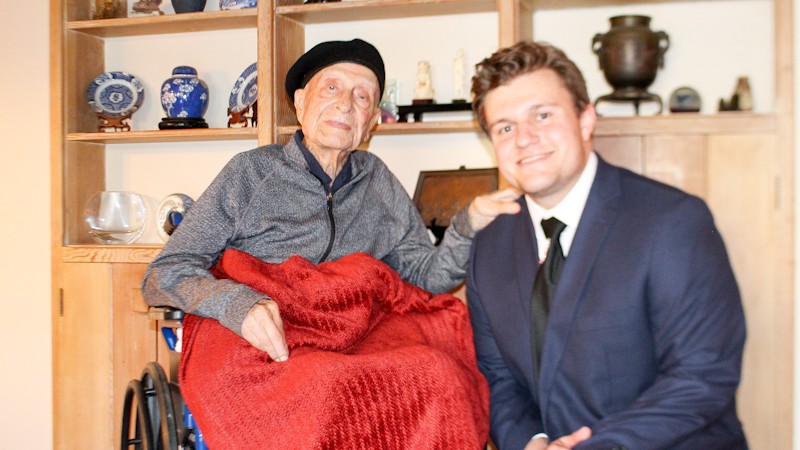
When I initially decided to pursue a fellowship through Teach the Shoah, I did so with the intention of learning more about public history. I felt understanding history’s utility outside of academia would benefit me. I did not expect to learn anything new about myself or for the content to connect emotionally with me.
But history was brought to life in a deeply intimate and powerful way, changing how I view my own life.
Meeting Joseph Samuels for the first time, an Iraqi Jew and 95-year-old Holocaust survivor, intimidated me. We were separated by seven decades and immensely different upbringings. However, our interviews quickly dispelled any notion that we truly were very different from one another.
Joe recounted many elements of his childhood that resonated with me and recalled my own memories, from his close yet at times combative relationships with his older brothers to the fear that a monster lived in his toilet. Even a century ago, sibling quarrels and imaginary monsters were among the troubles a young boy confronted while growing up.
The sense of similarity between our upbringings dissipated when Joe detailed his experience during the Farhud to me. Despite being so far removed from Germany, the consequences of Nazism and antisemitism reached Iraq and precipitated a violent massacre in Baghdad, the city where Joe grew up, in 1941. He viscerally detailed his experiences during this time and vividly highlighted a chapter of the Holocaust I was previously unfamiliar with. His story not only informed me about an aspect of history which had slipped through the cracks but also gave me a devastating understanding of what enduring such an experience is like.
However, our discussions also revealed the other parts of Joe’s life that might otherwise have been overshadowed by his experiences during the Farhud. After escaping from Iraq and eventually relocating to America, Joe began a new life. He established a successful real estate career, started a family, travelled the world, and restored his sense of community.
He could have just as easily succumbed to despair and allowed the atrocities he witnessed to determine his life. Instead, he took advantage of his tremendous good fortune and made the most of the opportunities that presented themselves to him.
And this remains true for the other survivors I met – despite the horrors they experienced, they lived incredibly rich and beautiful lives after the Holocaust. So often we forget that the stories of many who survived the Holocaust did not end with liberation: while many never moved on, perpetually grappling with their trauma or choosing to end their lives, many thrived after the horrific events they experienced and lived long, fruitful, and happy lives. However, these portions of survivors’ stories are often diminished or entirely ignored.
The stories of the survivors I met inspired and encouraged me, not only because of their incredible resilience and spirit, but also because they demonstrate the human capacity for rebuilding and restoring, that our worst experiences do not have to define who we are or what we can accomplish.
Even those who experienced the evils of the Holocaust – from the Farhud that Joe’s family narrowly survived to the concentration camps and the mass slaughter that occurred in Europe – were often able to prevail and begin again, unwilling to let the evil of antisemitism define them or limit their story.
Being in my final year of undergraduate study, still navigating the fallout of a medical trauma I had experienced several years prior and anxious about what awaited me after college, the stories of Joseph Samuels, Henry Slucki, and Eva Nathanson felt particularly pertinent to my own situation. They reminded me not only of the consequences of hatred and dehumanization, but also of our capacity to dictate our own lives and make the most of the future, even when our past feels inescapable and hope feels out of reach. We do not choose the circumstances we face or the challenges that confront us, but we do have the ability to decide how we respond.
This. This is another reason it is important to share these stories. Thank you for taking the chance to learn and to take upon yourself the stories of these people you had no connection with before hand. Your words have power.
What a beautiful story, focusing not only on the negatives that survivors — and people in general, to varying degrees — experience in their lives but also the fact that they/we have a choice in how they/we react to those negatives. Bravo!
Gabe:
What incredible life lessons you have learned and beautifully told here. I cannot wait to hear you tell Mr. Samuel’s Story!
Michelle Ultmann